Friday, May 27, 2022

Afghan Potato Salad

When trying to figure out what should accompany our chicken kebabs, I chose not to go with bread or rice. I had already slotted in the bread for a different Afghan meal, and it's hard for B to eat a ton of rice since he's a little toddler (wrote this post in June 2020; now he just likes to make rice "rain" so it's still not the easiest), so I try not to make rice every single day. (I try to look at it from his perspective. If I was working on my spoon skills and rice were difficult and sometimes frustrating to eat, would I want someone to make it every single day instead of also giving me something easier to eat?) After looking around at more recipes on Afghan Culture Unveiled, I found the answer - potato salad! The Afghan potato salad, shor nakhod, was egg-free and mayo-free, and it seemed like something our family would really enjoy. I don't know if it's remotely traditional to pair potato salad with chicken kebabs in Afghanistan, but grilled chicken and potato salad do make for a quintessential American BBQ, which is probably why it was so easy for my brain to accept the pairing.


The ingredients for the potato salad were:

- 3 large Russet potatoes ($2.37)
- 2 cans of chickpeas ($1.75)
- 1 bunch of scallions ($1.29)
- 1 bunch of cilantro ($1.99)
- about 1/2 cup white wine vinegar ($0.54)
- salt and pepper to taste ($0.03)

The cost for the potato salad was about $7.97, which isn't that much considering it was half of our dinner and it did make enough to have a bowl left over for lunch.


The steps for making the potato salad were:

1. Prep potatoes. Wash, peel, and chop the potatoes into bite-size pieces. Put in large pot, bring to a boil, and cook until fork tender. Drain potatoes and allow to cool. [I was busy doing other things, and the potatoes cooked too long. They were beyond fork tender.]

2. Prep scallions and cilantro. Chop both as finely as possible. [The original recipe makes the dressing in a blender or food processor. I really hate lugging those out, plus the noise, plus the lack of space for it on the counter while making other things, plus the noisy mini food processor scares B, so I just chopped them by hand. Took a little longer, and not as fine as a blender would get it, but it worked out just fine. Probably didn't even need to be as finely chopped as it was, although in the recipe photo, the food-processed version pretty much turns the potatoes green instead of seeing the herbs themselves. Much harder to do that without the processor.]

3. Make dressing. Combine scallions and cilantro with white wine vinegar, salt, and pepper. Season to taste. [Given that I used more potatoes and chickpeas and scallions than the original recipe, I needed more vinegar than the recipe, and probably could have used even more S&P.]

4. Drain chickpeas and rinse. Add to large bowl with the potatoes and the dressing. Mix well and season to taste.

The potato salad could be served warm or chilled. We had no room in our fridge to chill it, and I didn't make it far in advance, so I just left it under a fan for as long as it took to make the chicken kebabs. It tasted good, but so many salads work even better once the flavors have time to meld together and chill. We did have leftovers though, which I ate for lunch the next day, and the flavor of the dressing came through much more, which I really liked.


Overall, the salad was good, even if it was 75% of the way to mashed potatoes given how long I boiled the potatoes. Since it was vinegar-based, the sour flavors were predominant in the dressing, along with the strong bite of the herbs. I personally liked that a lot, but not sure B was that into it since he would normally eat more potatoes than he did. Despite being full of heavier ingredients like potatoes and chickpeas, the dressing gave the salad a lightness that I really liked. I would make this again, although I have a very long list of potato salads to try first!

Sunday, May 22, 2022

Afghan Chicken Kebabs

Going out to Afghan restaurants, we often got kebabs, eating delicious pieces of grilled meat over rice and with bread. If we were going to explore Afghan food, it only seemed right to include a kebab, and the yogurt-marinated kebabs I found on Afghan Culture Unveiled, kebab-e-murgh, looked and sounded delicious. The big issue we faced was that we don't have a restaurant-quality grill or any grill at all, and we needed to use our grill pan. But I was hopeful we would at least get close and have some tasty grilled chicken kebabs.


The ingredients for the kebabs were:

- 2 lbs of boneless skinless chicken breasts ($8.98)
- 2 cups of whole milk Greek yogurt ($2.75)
- garlic powder (a lot) ($0.05)
- about 1 tsp ground coriander ($0.20)
- about 1 tsp ground cumin ($0.10)
- salt ($0.02)
- freshly ground black pepper ($0.02)
- grapeseed oil for brushing grill pan ($0.20)

The cost for the kebabs was about $12.32, the majority of which was the chicken. We probably could have made less chicken or frozen chicken and reduced the cost, but didn't feel like defrosting the frozen chicken when we could get fresh, better-quality chicken on our grocery trip.

The steps we followed were:

1. Combine the yogurt, garlic powder, coriander, cumin, salt, and pepper in a large bowl. Slice up the chicken to desired size and cover with the marinade.

2. Put the chicken and yogurt marinade into sealable bags, and marinate chicken in fridge overnight.


3. Take chicken out of fridge about 30 minutes before grilling. [That was the plan, but it turned into an hour. The chicken seemed fine.]

4. Put chicken into a colander to allow yogurt marinade to drip off. If any marinade remains, wipe off as much as possible before grilling so the yogurt doesn't burn. [Writing this out, I just realized that maybe I was supposed to put it in the colander for at least part of those 30 minutes instead of just letting it sit out on the counter?]

5. Heat a grill pan and brush with grapeseed oil.

6. Grill chicken pieces until cooked through on both sides. [I am definitely not an expert at grilling. I never know when they're done and always worry about undercooked chicken, so it ends up overdone 80% of the time. Since the time I wrote that in July 2020, we have gotten an instant read meat thermometer.]

7. Once chicken is done, wrap in foil and allow to rest for 5 minutes before serving.


I also made a small portion of yogurt dip using the same recipe as the previous aushe burida, bolani, and borani banjan, but this time using dried mint. I think it turned out fine, although the fresh mint (and fresh garlic) gave the first version of the dip a much stronger flavor which we really liked. But for an everyday sauce, where you may not have fresh mint on hand unless you grow it since it goes bad so quickly, dried mint definitely works.


How were the kebabs? Not as good as they would be on a real grill. Not as good as they would be if made by someone who doesn't have a habit of overcooking chicken. Some pieces were kind of juicy, but others were dry. Probably because I also sliced them up rather unevenly given the shapes of the chicken breasts. The flavor was good, but it mostly just tasted like grilled chicken without any strong spice flavors. We haven't made a lot of yogurt-marinated meats but thought the yogurt was supposed to tenderize the meat, and these just seemed texturally like other grilled chicken we've had before. [Note: I learned when making Lebanese shish tawook later in the year that plain yogurt instead of Greek yogurt might make all the difference.] They made for a good dinner, but we might have to keep working on it to see if they improve with better grilling technique!

Friday, May 13, 2022

Borani Banjan

This post is almost exactly as written back in June 2020, which explains why the recipe is written and priced out, something I've stopped doing in the interests of time these days...

My initial plan for the Afghanistan section of the AtWCC was just the three dishes we previously posted about - aushe burida, kidney bean curry, and bolani. I was researching our next destination (Alabama, since I decided to mix the states in), but found I kept coming back to Afghanistan. I didn't feel done with it, especially since I didn't attempt even a simplified version of the national dish, kabuli pulao. (There will be some countries, I already know, where our style of cooking or dietary requirements aren't going to work with some of the national dishes, but that wasn't the case here.) As I kept reading, I kept finding more and more things I wanted to try to make, so I expanded our list for Afghanistan, planning out an entire week's worth of new recipes. Of course, the grocery store didn't cooperate and didn't have in stock very basic things like cilantro, so a lot of the recipes got postponed.

The one thing we were still able to make with what we got at the grocery store was borani banjan, a dish of Afghan eggplant with yogurt sauce. I modeled ours after the version I found on Honey & Dates, mostly because the eggplant there was baked and not fried. (We've already covered how I feel about frying.) The ingredients for our modified version were:


- 2 large eggplants ($10.25) *
- olive oil (probably at least 1/2 cup) ($1)
- 1 onion ($0.94)
- small bunch of fresh mint ($0.95)
- 28 oz can of diced tomatoes ($2.29)
- ground ginger ($0.10)
- ground turmeric ($0.10)
- salt and freshly ground black pepper ($0.05)
- garlic powder ($0.05)
- small spoonful of minced garlic ($0.10)
- about 1 cup of plain yogurt ($1.48)
- rice ($0.50)

* The eggplants should have only cost $5.11, but Fairway charged us for some organic Italian eggplants instead of the plain basic eggplants we got. We had mostly stayed at home before the day we went there, but decided to combine a grocery trip with some dentist appointments. Being in the store with their poor social distancing enforcement and lack of any visible ongoing sanitizing (compared to other stores that will do things like cleaning your cart - remember, this was June 2020) was the least safe we felt all day, and we just wanted to get out, plus the only place the prices were listed was on the screen behind the cashier and we were keeping our distance, so we didn't notice the massive overcharge until it was too late. They also charged us for the wrong onions, but that was far less egregious of an error. On top of having to scrap 70% of our shopping list/meal plan because the store selection had gone way downhill, this was very aggravating.

The total cost for dinner was approximately $17.81, almost entirely due to the ridiculous cost of those eggplants. It did not feel like great value for the money, since we know how much it should have cost. Thanks, Fairway.


The steps for making our modified version of the dish were:

1. Prep the eggplant. Wash and slice into rounds (not too thick but not paper thin either; the recipe said 1/4 inch but I didn't measure). Line baking sheets with aluminum foil and spray with canola oil spray. Lay eggplant rounds flat on the baking sheets and brush with olive oil so the tops and sides are coated. Bake for 30 min at 350 degrees and flip halfway through.

2. While the eggplant is baking (or in our case, since the eggplant didn't fit on two baking sheets, and I had to fill a third while the first two were already in the oven, leading to some delayed and scattered timing), start prep on the tomato sauce and the yogurt sauce by chopping the onion and the mint.

3. Heat olive oil in a pan over medium heat. Add the onion and cook until softened. Add the diced tomatoes (with only a little of the juices), ginger, turmeric, salt, pepper, garlic powder, and minced garlic. (I didn't measure any of the spices, so maybe a tsp of ginger and turmeric, a few grinds of S&P, and a lot of garlic? Season to taste, of course.) Mix well and cook (occasionally stirring) until the sauce has thickened. Add about 1/3 of the chopped mint, cook for another minute, and then remove from heat.


4. Add yogurt to a bowl with the remaining 2/3 of the chopped mint, a little salt, and a liberal amount of garlic powder. Mix well, and let sit until the rest of the components are finished.

[Side note on the yogurt sauce: This is basically the same yogurt sauce I've now made three times for our exploration of Afghan food, but we love it. This time, we used plain yogurt instead of plain Greek yogurt because it was what we had, but we prefer it with the Greek yogurt. The first time we made it with some fresh garlic added was, of course, the best. Many of the recipes talk about using dried mint, but we've used fresh because we haven't found any dried mint yet. One day, we'll find out which one we like better, because I doubt this will be the last time we make this yogurt sauce.]

[Also, a prep note: If the eggplant is finished baking (so that they're soft enough to eat) but nothing else is done (which was, of course, our situation), put the eggplant on a plate under aluminum foil to keep it warm and let it soften some more.]

5. Layer the dish with the eggplant on the bottom, the tomato sauce in the middle, and the yogurt sauce on top. Serve with rice on the side.


I don't actually remember if we ever tried this at the local Afghan restaurant in our old neighborhood, so I can't really compare, but overall it turned out okay. The tomato sauce and yogurt sauce were really tasty, and they worked well together, but the weakest part of the dish was the eggplant. I haven't made much eggplant before (I actually didn't remember ever using the big eggplants before, only Japanese eggplant or baby eggplants, but reading old posts, I was wrong about that, having made it very differently for escalivada), and I'm not sure if I baked them for too little time, too much time, or with too little oil, or what, but they were just not as soft and juicy as I would have liked them to be. I think if the eggplant texture had come out to what I envisioned in my head, that combined with the tomato sauce and yogurt sauce would have been delicious. We'll definitely keep this dish in mind if we ever see good (and affordable) eggplant at the store, and it'll give me another chance to get it right!

Monday, May 9, 2022

Kidney Bean Curry

I wrote at least part of almost every single post about our exploration through Afghanistan back in 2020 except for this one. The second dish we tried was a kidney bean curry since we had gotten a variety of curries during our orders from Ariana and they were all delicious. I have no idea what recipe I followed or what adaptations I made because I didn't take any notes. I don't even know exactly what went into the curry because I didn't take an ingredients picture.

Edit (May 2023): I found my notes for this dish! Apparently the curry included 2 cans of kidney beans, onion, garlic, zucchini, mint, ground coriander, turmeric, ground cumin, and tomato sauce. I still don't remember much about this, but at least it's no longer a mystery as to what was in it.


What I do remember is that we thought the curry was fine, but not very memorable. It had nice flavors, but was also kind of boring. That's probably reflected by the fact that I never wrote about it and remember nothing about it almost two years later. I would have skipped this post entirely since I don't remember anything, but it was our second dish for the AtWCC and I want to record it all.

I remember our next stop a little better - making the bolani, which was also for the 52 week cooking challenge - which was fine but also a little disappointing. I had made all three of our Afghan dishes for the challenge three days in a row, jumping straight into the challenge, and I thought I was done there, but the challenge was going to take another turn...

Friday, May 6, 2022

Kicking Off the AtWCC

The first country we explored for the Around the World Cooking Challenge was Afghanistan, and we started way back in June 2020. I really meant to recap these on time, and I actually wrote many of the posts back in 2020, so why did it take almost two years to get to this point? Because I had wanted to write WorldEats restaurant summaries of our Afghan food exploration first to show what we were modeling the dishes after, but that just never happened because it was a daunting task that I never seemed to have enough time to do. Since we're almost to our fifth stop on our world tour, it's time to get started, with or without the WorldEats recaps.

Aushak

My favorite Afghan dish is probably aushak, leek dumplings topped with a meat sauce and yogurt sauce. I mentioned this in my 2011 favorite food memories list, and we got it often when we went to Ariana, one of our favorite neighborhood places when we lived in Hell's Kitchen. (I've said favorite a lot in this paragraph, but aushak deserves it.) Aushak is a fair amount of work though, and I wasn't so good at making dumplings (still not great at it), so it was not how I wanted to start the challenge. But there was another dish at Ariana called aushe burida that we got a couple of times, which was sliced noodles with a very similar garlic and mint yogurt sauce and meat curry sauce that was kind of like aushak but with noodles instead of dumplings. I decided to start there to try to start off the challenge with a win.

Aushe burida, looks very similar to aushak

I couldn't find a recipe for aushe burida online, and every time I searched for it, I just got brought back to the description of the dish at Ariana, so I'm not sure if that's just one of their family recipes or if it's spelled differently elsewhere or what. So I pulled up an aushak recipe from Tara's Multicultural Table, used that to get some ideas about the sauce, and tried to adapt that from what we remembered about aushe burida at Ariana (which wasn't that easy since it had been years since the last time we had it), adding in some leeks as a nod to the flavor of the aushak.


There were three main components to the dish: the noodles, the meat sauce, and the yogurt sauce. I ended up with a yogurt sauce that consisted of plain yogurt, salt, a lot of garlic powder, a few cloves of minced garlic, and about 1/3 cup of finely chopped fresh mint. The yogurt sauce chilled in the fridge while I made the rest of the recipe. Although the aushe burida at Ariana was made with homemade noodles, I chose to just use dry pasta, because I definitely did not have time to tackle a separate pasta-making project too.


I made the meat sauce while the pasta was cooking using onion, garlic, a meatless crumble, salt, freshly ground black pepper, garlic powder (a lot), paprika, ground coriander, scallions, leeks, tomato sauce, and chopped fresh mint, all generally added in that order with the mint at the end right before taking off the heat. Traditionally, this sauce would be made with actual meat, but I don't cook much red meat at home and opted this time to use the Gardein beefless ground. It would probably work with any ground meat or meat substitute though. The bowls when assembled were layered with the noodles on the bottom, then the meat sauce, and lastly topped with the yogurt.


Overall, we liked the dish, and we thought the taste got close to what we remembered of the aushak and aushe burida at Ariana, but not exactly. We thought maybe it was the richness of the meat stewing in the sauce that was missing with the plant-based meat substitutes, so maybe something like Impossible Burger would be better since it mimics the flavor of beef so much more. Visually, the sauce also looked different from what we had at the restaurant because it looked like there were some yellow split peas in their sauce. Maybe there were also more secret ingredients that we couldn't guess.

We've made this several more times since then, mostly using the same recipe with some minor tweaks until about 22 months later when I tried a recipe from a cookbook I hadn't yet discovered the first time around (not surprising considering I wasn't really browsing library catalogs or cookbook lists less than 3 months into the pandemic). More on that another time!

Monday, March 21, 2022

Week 2 - Noodles

The Week 2 challenge, noodles, was one of those themes where it's so easy to find something to fit that it makes choosing something really difficult. I ended up picking ketchup spaghetti / spaghetti Napolitan from Just One Cookbook, something we've never had before. I had no idea that ketchup-flavored pasta was a thing in Japan, but it seems that ketchup became popular for the sauce because tomato sauce was rare in the post-war era. According to the recipe notes, it's still a fairly popular yoshoku (Western-influenced food) dish there, so it sounded like a good one to try!


I didn't make many changes to the recipe here so that it would be as authentic as possible, and combined some tricolor spaghetti with garlic chicken sausage, green peppers, mushrooms, and onions. The sauce was predominantly ketchup with some Worcestershire sauce, pasta water, salt, and pepper.


This was a very simple dish to make, perfect for a school night. While a ketchup sauce can't match the richness of a well-developed tomato sauce, I don't really think it's fair to compare, as they felt like two very different dishes. We really liked this, and it's nice to know now that ketchup is another option for pasta sauce!

Thursday, March 17, 2022

Week 1 - Weird Al

The 2022 challenge started off with Weird Al, and there were a lot of options here because there are a lot of Weird Al songs that deal with food. After a little looking around, I decided on the song Spam, because it was a good excuse to make something new with Spam, something that B absolutely loves to eat.


I ended up combining Spam with another thing that B loves - pizza - for a Spam Hawaiian pizza. Pineapples on pizza are controversial to a lot of people, but we love it, along with other more unique pizza toppings like bananas. That banana curry pizza from last year's challenge was one of our favorite things we tried, and our love for exploring different toppings on pizza has led to an additional development to the AtWCC (but I'll save that for another post whenever I finally get around to recapping those, hopefully soon).


Hawaiian pizza usually has pineapples, red onions, cheese, and ham, but here, I replaced the ham with Spam, for a delicious salty and tasty combo.


This was a big hit with our family, and we would definitely do this again. After a disappointing end to last year's challenges (that akutaq, if you missed it), it was nice to start the year on a high note.

Sunday, March 13, 2022

52 More Weeks Done

I can't believe it took me until March to finally finish writing about last year's 52 week cooking challenge, but here we are. It may have taken until the last day of the year, but I'm proud that I completed every single one. Here's the whole list:

Week 1 - last meal (copycat burrito bowls)
Week 2 - meat substitute (vegan meatloaf)
Week 3 - Indonesian (mie goreng)
Week 4 - confit (potato confit)
Week 5 - whole spices (chickpea coconut curry)
Week 6 - English (full English breakfast)
Week 7 - Mardi Gras (red beans and rice burgers)
Week 8 - comfort food (vegan corn chowder)
Week 9 - Korean (potato and cheese hotteok)
Week 10 - foam (focaccia)
Week 11 - hard to pronounce (chicken gyro)
Week 12 - banana (banana curry pizza)
Week 13 - stuffed (Paraguayan empanadas)
Week 14 - forbidden fruit (cheddar bay biscuits)
Week 15 - chocolate (triple chocolate mint cookies)
Week 16 - Hunan/Xiang (pearl meatballs with sticky rice)
Week 17 - one bite (mini meatloaf muffins)
Week 19 - Ecuadorian (pan de yuca)
Week 20 - julienning (carrots for pancit)
Week 21 - eggs (carrot coconut pancakes)
Week 22 - across the border (Jersey disco fries)
Week 23 - picnic food (Italian pasta salad)
Week 24 - inspired by a restaurant (Alice Springs chicken and blooming onion)
Week 25 - Italian (arancini)
Week 26 - folding (folded kimbap)
Week 27 - floral (lemon lavender doughnuts)
Week 29 - grilling (Hawaiian BBQ skewers)
Week 31 - coconut (coconut curry chicken)
Week 32 - Armenian (lahmajoun)
Week 33 - one color (tortilla española)
Week 34 - peaches (peach salsa)
Week 35 - Kenyan (irio)
Week 36 - yeasted (parmesan herb bread)
Week 37 - shells (fajita shell pasta)
Week 38 - earth, wind, and fire (BBQ cheddar chicken with 3 bean salad)
Week 39 - made two ways (soy two ways - loco moco)
Week 40 - a recipe you've been wanting to try (pork wontons)
Week 41 - German (toast Hawaii)
Week 42 - one pot (pumpkin chili)
Week 43 - single use gadgets (bacon cheese scallion waffles)
Week 44 - Native American/Indigenous American (akutaq)
Week 45 - brining (grilled brined carrots)
Week 46 - seeds (avocado bean salad)
Week 47 - Tunisian (lablabi and kesra bread)
Week 48 - ketchup (banana ketchup)
Week 49 - leftovers (Thanksgiving sandwich)
Week 51 - South Indian (rava dosa and aloo masala)
Week 52 - Toasting (avocado toast 3 ways)

Moving on to the 2022 challenge!

Week 52 - Toasting

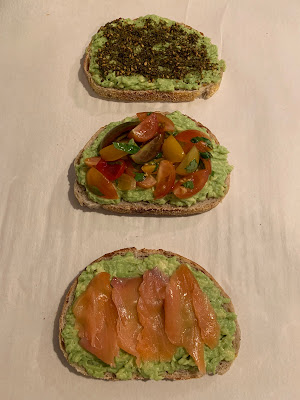
The final challenge of the year for the 2021 challenge was themed toasting. While toasting could be taken in so many different ways, I opted for toast with bread instead of a drink. One of little B's favorite Bumble Nums videos is centered on avocado toast, and he'd been wanting to try avocado toast for a long time, so why not? Thankfully this was back in December before avocado prices skyrocketed, so for toasting, I decided to make a trio of avocado toasts.


No real recipe here, just mashed up avocado (think one of those ended up being rotten, so used 4 mini ones), topped with za'atar, tomato-basil salad, and smoked salmon.


I don't know which one was our favorite or if we could even pick one because they were all good. B would probably pick the smoked salmon (he loves smoked salmon), but he did enjoy the za'atar one too. Mixing the za'atar and smoked salmon together also made for some good toast. With that, we've finally reached the end of (writing about) the 2021 cooking challenge, and it's time to move on to (catch up on) 2022!

Saturday, March 12, 2022

Week 51 - South Indian

I was thrilled when I saw that the Week 51 theme was South Indian, because as a family, we love South Indian cuisine. I was also a little intimidated though, because some of those recipes are a lot of work! Making dosas can take hours sometimes. In the end, I decided on rava dosa (adapted from a recipe on Indian Healthy Recipes) with some aloo masala from the same site. Did I pick rava dosa because it looked doable and wasn't an hours-long process? Maybe...


The first step was making the batter out of semolina, rice flour, all-purpose flour, salt, cumin seeds, black pepper, finely chopped onion, finely chopped curry leaves, finely chopped cilantro leaves, and ginger, with enough water to make it runny. The batter only needed to rest for 20 minutes before cooking, which was great. I had never bought fresh curry leaves before, but I made a special trip for them so I could make this (and some other Indian dishes), and I think I'm going to need them whenever I make South Indian food in the future. There really is just no comparable ingredient (that I know of).


The recipe instructions said to start with a hot pan, and to add just a few drops of oil and grease it with a sliced onion. I feel like I've seen them do something similar at restaurants, but had never tried it at home. Wow, that was a revelation. I used so little oil to make each one of these dosa, but they came off the pan so easily thanks to this onion trick!


The batter gets poured into the pan starting from the edges and then filling in the gaps. That reminded me of banh xeo, and it hadn't occurred to me before making this that they are both thin, crispy pancakes, so why wouldn't they be made similarly? The dosa toasts on low until the edges come off the pan and it's cooked through. I did flip them to finish cooking them, but might not be necessary. The one thing I didn't plan on was that each dosa takes a long time to cook (again, I wish I had thought of the banh xeo connection earlier, because it's the same thing there), like maybe even 10 minutes type of long. For multiple dosa, I hadn't budgeted in that type of time, and it made for a very late, kind of stressful dinner rush. The dosa were excellent though, and I would make them again. I would just budget more time than I did for them.


I followed the aloo masala recipe fairly closely, other than leaving out the chilies because of little B, and they were delicious. Not sure what more to say here about well-seasoned mashed potatoes, but I would make this again too.


With all the work going into the dosa and the potatoes, I didn't make any of the other sides that you normally get with dosa at restaurants, but I just didn't have the capacity to. Maybe next time, I'll buy some pre-made chutneys at the store when I get the curry leaves for a more full experience, but we were still really satisfied with this!

Monday, February 28, 2022

Week 46 - Seeds

I wasn't thrilled when I saw that the Week 46 challenge was seeds, because a lot of seeds are still choking hazards for little kids. But after reading some discussion about it and learning that beans are in fact seeds, I decided to try a new recipe for a bean-based salad from Once Upon a Chef.


The seeds part of the challenge was met with kidney beans, black beans, and chickpeas. I also topped the salad with some avocado. Although not using the seed itself, it does have a very large seed in the middle, so somewhat on theme!


Even though it was fall, I'm often looking for salads to lighten things up, and this one definitely worked for that. I would make this again!

Sunday, February 27, 2022

Week 44 - Native American/Indigenous American

We've finished the Alaska section of the AtWCC (although, of course, I haven't written any of it here yet, since we still have to post all of Afghanistan and Alabama), but this was not the post I wanted to write to kick off the series. This dish was technically the last thing I made for the Alaska part of the AtWCC and also the last thing we tried from the 2021 cooking challenge, but it was a bit of a disastrous experiment and did not end either on a high note!

One of the things that I was most intrigued by for our Alaska exploration was a dish called akutaq, sort of like a Native Alaskan ice cream. In Alaskan tradition (more on Wikipedia), it seems like this was made with whipped fat (like from moose or walruses) mixed with meat (like dried fish) and berries, making it a very hearty meal, and was also sometimes made with fresh snow. These days, the fat is often substituted with vegetable shortening or Crisco, making it more accessible for those of us not in Alaska and also those of us who might not want to work with actual animal fat. Even with that change, I'll admit that I was a little nervous about making this and just ingesting that much pure fat, which is probably why I kept procrastinating and it ended up being the last thing we made for Alaska.


I followed the recipe from Spoon University, and it sounded so easy. Liquify the shortening (but don't let it get too hot), dissolve the sugar, add water to thicken it up, fold in the berries, and then put it into a container to freeze. I didn't think any of the steps would take too long, so the first thing I did was to take out a bag of frozen berries and chop them up a little bit. I didn't want whole frozen berries in case they were too hard for B to eat, so I thought that smaller pieces would work better and still contribute the same flavors.


Next up was taking out the shortening and then dissolving the sugar. Except... the sugar didn't dissolve, and the internet seems divided on whether it actually should dissolve in pure fat if you're doing something other than creaming it (which this was too liquid to do). I don't know all the science behind it, but what I do know is that ours did not dissolve whatsoever. I resigned myself to having crunchier sugar parts, which wouldn't be the worst thing in the world, and moved on to the water step, which didn't really thicken up anything.


I kept trying and trying to make it act the way the recipe said it should, but it didn't, so I eventually gave up and decided to fold in the berries and hoped it would just freeze in some form or another. Except... the berries by that point, since it had taken so long to try to dissolve the sugar and thicken up the mixture, were all melted and full of fruit juice, and then for some reason, adding the cold berries into the mixture took it from somewhat creamy and smooth to weird and curdle-like. I just threw the whole thing into a container hoping the freezer would sort it out, knowing it could be more icy than creamy with the higher liquid content. Even though it looked like berry quinoa once I got it into the container, I thought maybe, just maybe, it would be fine.


We put it in the freezer, and we were supposed to eat it later that day, but we were full. Then we were supposed to eat it the next day, but never got around to it. Were we just afraid of how it might taste and subconsciously finding every excuse possible? Maybe. We finally tried it the next day, and let's just say the freezer did not fix it. Those clumps that looked like quinoa? They were like little lumps of fat sweetened by berries, and although the overall taste wasn't awful, the texture was just too hard for us to get past to eat more than a few bites. Even A, who pretty much eats everything and has far less textural aversions than I do, just couldn't do it, and while I hate throwing food out, this was just not going to work.

We'd had a pretty great experience on our Alaska journey to that point, so it was kind of disappointing to end on such a low note, but I had to remind myself that not all cooking experiments work. I think lately I've just been going into it expecting to add everything to our family cookbook, forgetting that we do encounter quite a few failures. Often, I'll try again (my attempt to bake mozzarella sticks over and over again, for example), but I think we might just let this one go this time.

Wednesday, February 23, 2022

Week 36 - Yeasted

Oops, fell behind on these recaps again. Where did February go?!


Anyway, back to challenge week 36, yeasted. I made a lot of bread in 2020. I'd say, thanks to some cooking classes, it was the year I actually learned how to make bread versus following a recipe. When this challenge rolled around, it had been a while since I last made bread, so I hoped that it was like riding a bike and I'd remember what to do.


I decided on a garlic parmesan herb bread from The Stay at Home Chef, and started off by setting up the yeast. Only... not much happened. Our yeast had been in the fridge for a while, since we bought a giant bag instead of packets (it was all we could get at the time since everyone was making bread at that stage of the pandemic), so it was definitely possible that the yeast was dead. Or maybe the water was too hot. I tried again with a packet that was definitely not expired. It was better, but I was still worried that it wasn't going to turn out right, since the yeast still didn't feel as "responsive" as in the past.


In the end, the bread turned out fine. I still don't know if anything will top how I felt after the sage bread I made back in 2020 where I was shocked that I actually pulled that off. This one made two small loaves, but it didn't rise quite as much as I thought it would. Still tasty though, and it went well with our roasted asparagus, zucchini, and clam strips. Maybe I just need to bake more bread to remember what to do!

Friday, February 4, 2022

Week 35 - Kenyan

I love the challenge weeks that focus on different countries or regions of the world, because they can really push me out of my comfort zone to try something new (sort of like the whole AtWCC). I had zero familiarity with Kenyan food when this challenge came around other than a tilapia dish I made in a cooking class, so I blindly searched around until I found something that sounded both doable and delicious. I decided to try something called irio, following a recipe from Eat Well Abi. The site notes that the word irio means food and originates from the Kikuyu and Meru tribes in Kenya, and that the same dish of mashed food is sometimes called mukimo.


Irio is basically potatoes mashed with corn and green beans, and this recipe also added caramelized onions (instead of fried), which I love. It was pretty straightforward to make. We ate it along with some chicken tenders and grape tomatoes. I'm sure that's not traditional, but we always try to make sure we have some familiar foods on the plate for B when we try something new.


This was a really hearty and filling dish, and I think I would make this again, maybe next time alongside some other Kenyan dishes. I don't know how long it's going to take to get to Kenya since we're still doing countries starting with A, but someday!

Wednesday, February 2, 2022

Week 34 - Peaches

Peaches sounds like an easy challenge, but I had a tough time with this one. I didn't want to buy actual peaches, because I sometimes get a contact allergy to the skin, so I wasn't sure of the best way to go. Peach jam? Canned peaches? Honestly, I just wasn't feeling very inspired when it came time to plan this one. Eventually I settled on using the peach fruit cups we already had, because why buy something new for a challenge you don't even really want to do?


I ended up making a peach salsa with the peach fruit cups, some Roma tomatoes, a big green pepper, half a red onion, a big pile of cilantro, and some lime juice. Fair amount of prep, but easy to do. We ate it with some cheeseburgers and bagels (I know, not the combination you were expecting), and it worked for a summer dinner.


The salsa itself was fine. It didn't have much peach flavor, but they weren't fresh peaches and there wasn't that much peach compared to some of the other flavors. I probably wouldn't make it again (at least, not like this).

Sunday, January 30, 2022

Week 28 - Danish

So many recipes sounded good for Danish week, but after much deliberation, I decided on meatballs (frikadeller, based on a recipe from Scandi Kitchen) paired with mashed potatoes (specifically, brændende kærlighed, which were topped with onions and bacon and based on a Nordic Food Living recipe; I will probably just refer to them as the mashed potatoes from here on, since I don't know the keyboard command for the æ letter).


I love meatballs, all different variations, but this was my first time eating or making Danish meatballs. According to the Scandi Kitchen site, meatballs are so common that they're eaten about once a week, warm with boiled potatoes (with parsley and butter, sounds delicious), gravy, and pickled cucumbers, or cold with potato salad, on sandwiches, and other ways. We had them with mashed potatoes and green beans, so not any of the "typical" ways, which means we might just need to make them again "properly" whenever we get to the Danish section of the AtWCC. (Or maybe I'm just looking for an excuse to make meatballs again, because I love meatballs.)


The original recipe for the meatballs was made with veal and pork, but since I don't really cook much red meat at home, I just went with a really fatty ground pork. I also made some other substitutions, like flax eggs, oat milk instead of whole, Better than Bouillon instead of a stock cube, panko breadcrumbs instead of fresh. The most interesting ingredient to me was the addition of sparkling water. I had never put those in meatballs before, and I was curious to see how it would change the texture.

Alongside the meatballs, we also made the mashed potatoes, which were fairly straightforward and just topped with onions and bacon. Can't really go wrong with that combination.


We really enjoyed this meal. We've had much more exposure to Swedish meatballs, but these Danish meatballs were delicious. I would definitely make these again, and I think they're going to be on the list for revisiting whenever we decide to focus on Denmark for the AtWCC. Maybe we'll do them both warm and cold!

Monday, January 24, 2022

Week 27 - Floral

Wow, where did the past couple of weeks go? I thought I'd be done with these challenge recaps for 2021 by now, but seem to have lost steam after the big end-of-year push. Time to get back into it!

The floral challenge took place back in July, but it turned out to be the last challenge I completed for the year (on the last day!). I intended to make it earlier, but I had decided on lemon lavender donuts based on a recipe from Short Girl Tall Order, and first, I needed to get a donut pan. (We actually got some silicone donut baking cups, but same thing.) Then, I had to get pastry flour, which wasn't always available during our online shopping (and isn't sold at places like Trader Joe's). Once I finally had that, I just never seemed to find the time or energy to actually make them until right up against the deadline.

Had extra batter after filling the cups so made "cake"

Making the donuts didn't turn out quite how I expected either. (New Year's Eve seemed like a cooking day full of mishaps anyway - just wait until the Week 44 post.) I followed all the instructions, but the batter was super thin and runny, thinner than most of my pancake batter. That didn't seem quite right, and I wasn't sure how it would hold together, so I added more pastry flour to it until it thickened up. I put the batter into the cups, and shockingly, they did turn into actual donuts, but they still fell apart pretty easily. I'm not sure what I did wrong.

Little B couldn't even wait for them to be glazed before eating one

I made the glaze and added more powdered sugar to make it thicker, but even after dunking the donuts in the glaze on all sides, you can't even see it on there. It was definitely there, and they were sticky from the glaze, but this is not what glazed donuts should look like (in my opinion). Again, not sure what I did wrong.

Invisibly glazed

I don't think the problem is the recipe since it turned out some great-looking donuts there, but my first adventure baking donuts didn't turn out too well. I haven't given up completely and will try again another time, but for now, maybe I'll just stick with cookies. Even though I was disappointed with my final product, it wasn't all bad though. It was the primary thing B ate for New Year's Eve night, and he really seemed to like them, so I'm still glad I made them.

Saturday, January 8, 2022

Week 26 - Folding

Remember the TikTok quesadilla that went viral last year? (I originally wrote earlier this year, but it's not 2021 anymore.) The one where you put something in each of the four quadrants and then folded it over to make the perfect quesadilla? Once that started appearing everywhere, so did variations on the quesadilla, including folded kimbap, which was what I decided to make for the folding challenge last summer.


I decided to make ours with sticky rice, sliced cucumbers, spam (which I think I cooked with a glaze similar to the one for spam musubi, but don't know for sure because this was back in July and I didn't take any notes), and some jarred kimchi.


I followed the same method for cutting and then folding the kimbap, but it didn't turn out that evenly spread out or photogenic. There were several bites of just seaweed or seaweed and one other ingredient. Once I got to the part where it was all together, it did taste good, but it wasn't quite as easy as I was expecting it to be. Honestly, I think I'd rather just throw all the ingredients over some rice in a bowl, and would probably do that instead of this folded version next time.