Showing posts with label Japanese. Show all posts

Friday, December 30, 2022

The First Third

Making our way back to the beginning of the challenge before next year's challenge starts, here's a group post from the first third. Besides the ones already posted, skipping weeks 3, 8, 9, 12, 13, and 15 for the AtWCC (managed to fit in a lot!) and week 6 because I wrote most of that one already.

Week 4: on a stick


I had high hopes for this Serious Eats tsukune recipe, because those Japanese chicken meatballs skewers are one of my favorite izakaya dishes, but these were just okay. Considering we made these almost a year ago (I really need to get better about more timely writing), I don't remember a lot about them except that they didn't live up to my expectations. I don't know if it was because we had to use an egg replacer, or because they were made on a grill pan instead of an actual grill, or what was different about ours, but they just didn't taste as good as the ones you would get at an izakaya. Because I love tsukune, I do want to give them another shot whenever we make our way to the Japan section of the AtWCC, so I'm not counting them for that here.

Week 5: plant milk


I decided to go sweet for the plant milk challenge to try something different instead of just using store-bought plant milk as a substitute in dishes like we often do. First, I made some vegan condensed milk based on a Make It Dairy Free recipe (far easier to do than I thought it would be), and then used that to make some lime coconut snowballs (a MyRecipes recipe). They were different than how I thought they would come out. I was anticipating something solid and chewy like cookie dough, but they were soft and sticky, plus incredibly sweet. Tasty, but I couldn't eat more than a couple at a time because of how sweet they were. B and his sweet tooth liked them a lot.

Week 7: molding


The molding challenge was a complete failure. I made, or tried to make, dinosaur fruit jellies based on a YouTube video from Let's Stella. They looked so simple to make - Naked juice smoothies, sugar, and corn starch set in an ice cube mold. I got some cute dinosaur molds, thinking that we'd have lots of juice-filled fruit snacks that would be healthier than the store-bought ones. Except they didn't set. There were also supposed to be orange ones but I couldn't get those out of the mold at all. The taste was fine, but they were not the jellies they were supposed to be.

Week 11: inspired by art


I always have a little difficulty with the "inspired by" weeks, whether it's movies or TV shows or video games or books or art. I guess I'm not very inspired. The only thing that came to mind for this (besides a Mondrian cake, which I am not talented enough to make) was Campbell's soup, based on Andy Warhol's Campbell Soup Cans. I found a recipe for tomato soup meatloaf at The Kitchen Magpie, and I went with that, subbing turkey for the meat portion. This was over 9 months ago, so I don't remember much about it except that it turned out a little too watery on the bottom and it had nice flavor from the tomato soup. We have other meatloaf recipes we like more, so we'll probably stick with those, but this was nice for the novelty.

Four more recaps done, 24 more to go (at least it's less than half a year?)!

Sunday, June 18, 2017

Uwajimaya Food Court

When we got to Uwajimaya, we were pretty hungry. Although we wanted to investigate the store, we thought it would be a bad idea to do that on an empty stomach, so we stopped at the first stall in the food court that looked good to us. It happened to be the very first stall right next to the doors, but not that surprising that we stopped there since we like takoyaki.


We placed our order and then waited for a short time as they put together the takoyaki. Since they were freshly made, they were pretty hot when they got to us. We only had a thin stick to eat them with, which when combined with their temperature, made it more challenging to eat.


The takoyaki was good and tasted as we expected it to. The only problem was that not long before our trip, we had stopped by Otafuku in the East Village for some takoyaki, and we've never had better takoyaki than Otafuku (haven't been to Japan), so it suffered a little bit in comparison. The batter here wasn't quite as good as Otafuku, and the octopus came out a little on the chewier side, but as a pre-shopping snack, it definitely worked.


After buying some grocery souvenirs and snacks (probably too many, but that's the usual, and at least we did already eat most of the snacks), we were still hungry. We had planned on visiting Pike Place Market later in the afternoon and food crawling, but it was still a decent walk to get there, so we got one more snack from Uwajimaya.


Right near the registers, there was a deli-like counter with a bunch of different prepared foods from Chef Kenzo, including a bunch of different croquettes - shrimp, kabocha squash, and plain (which was potato). We decided to get one of the shrimp and one of the squash and split them. The croquettes came with a small sauce on the side. Not sure exactly what that was, but it tasted both a little salty and a little sweet. Neither of us really liked the sauce that much and preferred the croquettes without it.


Both croquettes were nicely deep-fried. Between the two, the shrimp one had more flavor and you could see the actual pieces of shrimp inside. The squash one didn't have a ton of flavor to it, but it was kind of comforting, sort of like mashed potatoes are.


There were a lot of stalls at Uwajimaya's food court that had more substantial food that would probably have been healthier than what we got, but we were just looking for something small for a snack. Overall, we had a nice visit to Uwajimaya. Not sure if we would go back on another Seattle trip, just because we have Asian grocery stores and food courts at home, but we're glad we went.

Monday, June 5, 2017

Week 19 - Tea

We have a lot of tea at home, but when the tea challenge came up, I really wasn't sure what to make. I didn't want to make dessert, and nothing really inspired me until I looked through what other people submitted for the challenge and saw something I had never heard of called ochazuke. A simple Japanese dish, it's made by pouring tea (or dashi or a combination) over rice and savory ingredients. After reading more about it, it reminded me a lot of a dish we had gotten in Vancouver, but we just hadn't known this was what it was called.


Since ochazuke is usually made with green tea, I decided to use genmaicha, in part because it's one of my favorites and in part because I thought the roasted rice flavor would go well with the cooked rice. (If you're unfamiliar with genmaicha, it's green tea combined with roasted brown rice.) Apparently the other common teas used besides genmaicha are sencha and hojicha, and I'm not sure if we even have either of those at the moment. I wasn't sure how the savory ingredients would go with the tea alone, so I decided to experiment and for each of our two bowls, make one with just tea and one with a tea/dashi mix.


The ingredients for the ochazuke were:

- 2 cups (uncooked) brown rice ($2)
- smoked salmon ($7.26)
- 3 green onions ($0.30)
- 1 package of Maui onion seaweed snacks ($0.33)
- 1/2 tsp of sesame seeds ($0.10)
- 3 genmaicha tea bags ($0.50)
- small spoonful of Hondashi mixed with water ($0.15)


On the side, I also made sunomono (based on a Japanese Cooking 101 recipe) because I wasn't sure there would be enough vegetable matter in the ochazuke alone. Unfortunately, the time I went to Trader Joe's they were out of the non-organic Persian cucumbers, so I had to go with a regular hothouse cucumber, which probably contributed to this not being as good as we had hoped. I probably also made too much sauce for it and should have drizzled it in instead of pouring in the whole bowl at once, as the salad was a little too drenched. It tasted fine, but just like cucumbers with soy sauce and vinegar, nothing we need to do again. I mention all this now because I was so unenthused about it that I forgot to even take a picture of the finished product. Anyway, the ingredients were:

- 1 hothouse cucumber ($1.29)
- about 1 tbsp sugar ($0.10)
- 3 tbsp rice vinegar ($0.25)
- splash of soy sauce ($0.05)
- a few shakes of sesame seeds ($0.10)

Combined with the ochazuke, that put the grand total for dinner at approximately $12.43, but that wasn't surprising since smoked salmon isn't cheap. We need to eat more fish on a regular basis though, so no complaints.


The first thing we did for this was start the rice since that would take the longest to cook. While the rice was cooking, I made the sunomono and also did prep for the ochazuke. The prep steps were to chop the scallions, tear up the sheets of seaweed, toast the sesame seeds, make the dashi, and of course to steep the tea.


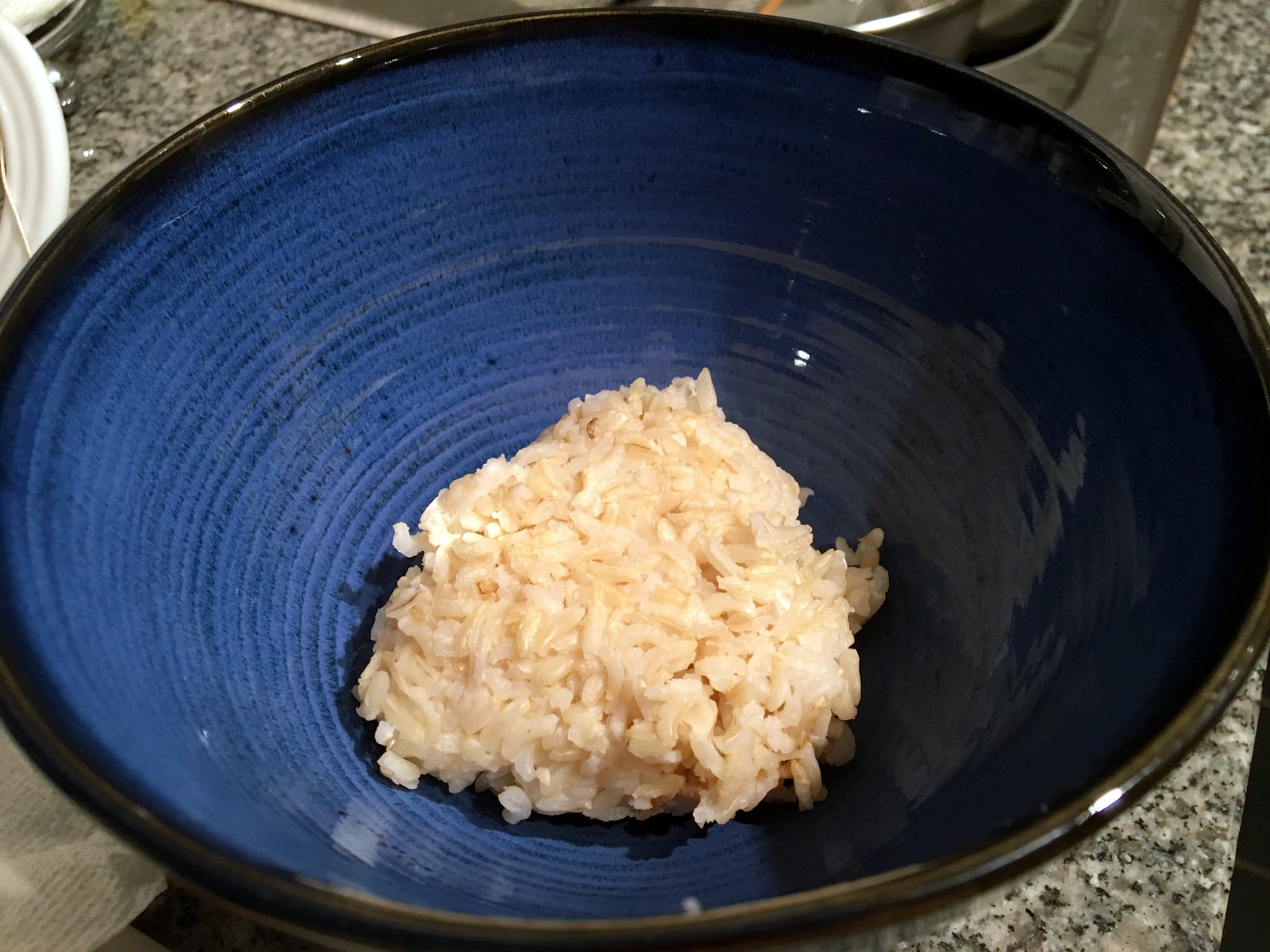
I remembered one of the sites that I had looked at about ochazuke talked about cooking the rice so it would get some nice browning. We tried doing that with some rice patties, but it didn't really make much difference so we only did it for the first bowl.


This dish was basically all about prep, and once everything was prepped, it was easy. A ball of rice at the bottom, and then layer on the toppings of salmon, scallions, seaweed, and sesame seeds. (I just realized those all start with S!)


After everything is in the bowl, you pour over the tea (and/or dashi) and then let all the ingredients soak in the broth. It ends up being kind of like having soup.


The ochazuke wasn't bad - very light and healthy tasting - but also not amazingly flavorful outside of the delicious smoked salmon. The tea didn't have as much flavor as we thought it would, and it definitely tasted better once we added the dashi. It was good though to have such a healthy, simple dinner.


I don't know that I would plan to make this again since it was good but not amazing, but outside of the smoked salmon, we have pretty much all the ingredients on hand most of the time, so it might work as a good way to use up ingredients sometime. What this dinner really did more than anything else was remind me that I should incorporate smoked salmon into more dishes. So much flavor, and a little bit goes a long way. It's basically the fish equivalent of bacon.

Thursday, April 20, 2017

Week 12 - Dorm Food

When I think about dorm food, the thing that immediately comes to mind is ramen. We weren't technically allowed to have cooking devices in the dorms, but a lot of people did, especially those little hot pots. One thing you could make with those was cheap packaged ramen, so making an "upgraded" ramen seemed perfect for the challenge.


I went with a spicy ramen with tofu recipe from Pinch of Yum as a starting point since I had never made anything ramen-like before, and went from there. The ingredients list, with our adaptations, is:

for miso paste (all approximations other than the miso, only thing I measured):
- 1/3 cup miso ($1)
- 1 small spoonful gochujang ($0.50)
- 1 heaping spoonful minced garlic ($0.30)
- about 2 tsp ginger paste ($0.30)
- about 1.5 tbsp mirin ($0.30)
- about 1 tbsp grapeseed oil ($0.10)
- a couple tsp toasted sesame oil ($0.15)

other ingredients for ramen:
- grapeseed oil for sautéing ($0.10)
- 1 package of firm tofu, sliced ($1.32)
- 1/2 large red onion, sliced ($0.49)
- a handful of dried shiitake mushrooms, rehydrated, stems removed, sliced ($0.50)
- 4.5 cups of water ($0)
- 2 spoonfuls chicken bouillon ($0.75)
- 1.5 cups water from shiitake mushroom rehydration ($0)
- 3 eggs ($0.30)
- 2 rice ramen cakes ($1.50)
- 6 green onions, sliced, whites and greens separated ($0.65)

The total cost for dinner (which had no leftovers) was about $8.26. Not bad at all for a complete and filling meal.

The steps for our version of the ramen were:


1. Place shiitake mushrooms in warm water to rehydrate.
2. Heat grapeseed oil in large pot and add tofu to fry. [I intended to have larger pieces of tofu but it broke up a lot when frying it. Not a big deal to us.]


3. While tofu is frying, mix together all ingredients for miso paste and adjust seasonings to taste if needed.
4. When tofu is mostly done, add a couple spoonfuls of miso paste to tofu and mix in. [This is where the tofu mostly broke up.]
5. Remove tofu to separate bowl.


6. In the same pot, add a little more grapeseed oil and then add the sliced mushrooms and onions. Cook until beginning to soften and then add a few spoonfuls of miso paste and cook for a few more minutes.
7. Add the chicken stock (water plus bouillon) and water from the mushroom rehydration bowl. Start to stir in miso paste one spoonful at a time and stir to help dissolve. [I probably added a little every 5 minutes or whenever I remembered as we made other things.]


8. While cooking the mushrooms/onions in chicken stock, soft boil the eggs. [I followed the instructions from the inspiration recipe - add eggs to boiling water, cook about 7 minutes on lowest heat setting, run under cool water, and then peel. Unfortunately (a) the first egg I dropped in cracked a little on the bottom of the pot so it broke which is why we ended up doing 3 eggs instead of 2 and then (b) the water didn't cover the eggs so we had to add some more water from our hot water heater on top. The timing still worked out fine for the egg texture, except peeling was an adventure as only one egg stayed intact. Clearly I've never made soft boiled eggs before.]


9. When the eggs are done boiling and are cooling, cook the ramen noodles according to the package instructions. [Took less than five minutes for us.]
10. Add the white parts of the green onions to the broth when you drop the noodles in the boiling water.


11. Once everything is done and tastes right, start assembling the bowls. Ramen noodles on the bottom, topped with tofu, then broth, and topped with the soft boiled egg and the green parts of the scallions for garnish.


Overall, this ramen experiment was pretty good. The texture of the noodles themselves weren't exactly what I was thinking they would be, as they were much thinner and less substantial than I had imagined. The broth didn't have the depth or nuance that a lot of ramen restaurants around here have, but I wasn't surprised by that as I used chicken bouillon and didn't make a bone broth or anything. Since we have so much good ramen around here, this seemed less like that and more like a good miso-based noodle soup which was just fine for dinner. (I mean, how much does dorm room packaged hot pot ramen taste like real ramen places?) I really liked the miso paste here, and could see using that combination for something else too, like sautéed vegetables. Pretty happy with how this turned out for dinner on a cold night.

Tuesday, March 7, 2017

Week 7 - Black and White

It was difficult for me to figure out what to make for the black and white challenge, mostly because I love cooking with color and didn't want to make dessert. I had absolutely no idea what to do and was pondering just putting a simple white fish on top of black rice, when A had a good idea - cacio e pepe.  I thought that would work, but wasn't 100% into it because I would have to buy white pasta (try to avoid that for health reasons) and it would be predominantly white with just black pepper for the black side of the challenge. Before a visit to a Chinese grocery store, I mentioned to A that I was considering something different, a soup with black rice, tofu or fish balls, and maybe some white vegetables, like daikon. His response was, "Oh, you mean oden?" Yeah, oden would pretty much be the natural evolution of the soup I was considering. With that idea in mind, everything came together much more easily.


The ingredients for our version of oden were:

for the broth (we used a recipe from The Kitchn as the basis for the ratios):
- 8 cups of water ($0)
- Hondashi soup stock granules, to taste ($0.40)
- 8 tbsp soy sauce ($0.60)
- 2 tsp sugar ($0.20)
- 4 tbsp sake ($0.60)

the rest of the ingredients:
- lotus root (about 1.5 lbs) ($2.65)
- daikon radish (we had a 4 lb daikon (yes, seriously) and used about 2/3) ($1.64)
- a couple of handfuls of dried wood ear mushrooms ($0.76)
- 1 small winter bamboo root ($1.91)
- 1 block of firm tofu ($1.32)
- 1 package of pollock fish balls ($1.99)
- 2 small packages of enoki/seafood mushrooms ($1.98)
- olive oil for sautéing ($0.10)

on the side:
- 1 cup uncooked black rice ($1)

Not the cheapest meal, coming in at $15.15, but probably less expensive than most oden recipes since a lot of them include a lot of seafood or fish balls. We went for simple but hearty for a cold night, and it made enough that we had enough leftovers for another dinner.


The steps for making the oden were:

1. Soak wood ear mushrooms in warm water to rehydrate. (By the time I was ready to chop these, it was at least 20 minutes later.)

2. Start the broth with the water and the dashi in a large soup pot.

3. Prep work - peel and chop daikon, peel and chop lotus root, peel and chop bamboo root (this was our first time doing this and quite an adventure as we kept peeling and peeling and didn't know when to stop and ended up with very little bamboo shoots), press tofu to release water and then slice, chop wood ear mushrooms once rehydrated, chop mushrooms.

4. Boil water in small separate pot and cook bamboo shoot until tender. (We had no idea what to do with this root but one site we read mentioned that it could be bitter and the water might need to be changed, which we really couldn't do with the soup stock.)

5. Heat olive oil in small skillet, and begin searing the tofu in batches (just to make sure it doesn't break up in the soup pot).

[Since A and I were doing this together, a lot of these prep steps overlapped.]

6. Add the other broth ingredients to the stock.

7. Once the broth tastes right, start adding the vegetables, fish balls, and tofu to the pot. (We did it in order of how long we thought things would need to cook, like lotus root first.) Simmer for about an hour (or more).

8. At some point while the soup is cooking, make the black rice. (Took about 40 minutes.)


We were really happy with how the oden turned out. Was it perfectly authentic? No, probably not, but it made use of what we had and what looked good at the store, and it had to be within the confines of the challenge, so only ingredients that were black and white. The soy-based broth was really good, very clean and light and healthy, and the entire stew just felt right for winter. Although oden often has large pieces of vegetables, I think next time I would chop the daikon and the lotus root into pieces a little bit smaller so that they mesh better in size with the other ingredients, and we would leave out the bamboo shoots (at least the fresh kind) since they were barely in here anyway. We would definitely make this again, maybe with different/more ingredients when we have the flexibility to have color!

Saturday, December 10, 2016

Momosan Ramen

It's getting really cold here in NYC which means it's good weather for ramen and other noodle soups. We were over in Bryant Park looking at the holiday shops last weekend, and decided to try someplace new for dinner. Chef Morimoto's ramen shop, Momosan, opened back in the spring, but we hadn't made it over to Murray Hill yet to try it, so this seemed like the perfect opportunity.


Everything on the menu looked so good, but we managed to narrow down our choices to two bowls of ramen and an appetizer. We often over-order, but the tables at Momosan are mostly communal, so if we ordered a lot more dishes, we probably would have looked like giant pigs to all of our neighbors with their single bowls of unfinished ramen.


For our appetizer, we went with the tetsunabe pork gyoza ($10), which was pork and chive gyoza served on an iron skillet (that would be the tetsunabe). A word of warning if you order the gyoza - the hot plate with the gyoza comes out, and then they pour sake on top followed by the ginger scallion sauce. It sizzled a lot and there were lots of little pops of oil all over the table and our phones (and probably our clothes). The gyoza themselves were good. The pork and chive filling was hearty and flavorful, and the ginger scallion sauce balanced that out nicely. Four gyoza for $10 isn't cheap, but they were really tasty.


For the ramen, we decided to get two different types so we could try more. A chose the tonkotsu ramen ($13 for the regular/large, $10 for a smaller portion; we got the larger one for both) with pork chashu, aji-tama (soy marinated egg), takana (pickled mustard leaf, not sure if that is the same as the Chinese pickled xue cai but it tasted like it), kikurage (wood ear mushrooms), toasted nori, garlic oil, and soy tare. The tonkotsu ramen also had scallions in it even though they weren't listed. This ramen was really good. The broth had so much depth and richness to the flavor, and all the vegetables included complemented it well. The chashu was soft and tender. Everything about this ramen was good.


I chose to go with the Tokyo chicken ramen ($12 for larger, $10 for smaller size) which had steamed chicken, aji-tama, menma (soy braised bamboo shoots), seared garlic chive, kikurage, toasted nori, and soy tare. After trying the broth in A's tonkotsu ramen, the broth in the chicken ramen seemed a little more one-note. It lacked some of the nuance and the depth that the tonkotsu ramen had. It was still good and had a lot of flavor, but just not as good as the other one. This ramen had menma and garlic chives instead of the takana and scallions; personally I would have preferred the second but these were good and probably were better with this broth. The aji-tama was delicious, and good in both ramen bowls. Overall this chicken ramen just tasted very clean.


The Momosan menu had a page devoted to the concept of "nobiru," which they described as "the condition where noodles absorb soup and get soggy." They apparently worked with Sun Noodle to develop noodles more resistant to that condition, which held their texture for longer. The texture did seem to hold up better than some other places, which was good since I tend to eat slowly. As far as the amount of food, we were pretty satisfied but not stuffed. That just meant that a few hours later we had room to eat some freshly baked cookies to celebrate National Cookie Day. Overall we really liked our visit to Momosan and are already plotting when we can return to try all the stuff we didn't get to this time.

Saturday, August 13, 2016

Team Mystic

Some days you just want some sushi. That was how we found ourselves at Ajisai, our neighborhood sushi joint (previously posted here), yesterday after a late visit to the gym. Although there were a lot of appetizers and hot food on the menu that sounded tempting, we decided to stick with rolls.


We ordered a sushi combo (which came with a salad or soup) along with 3 individual special rolls. The salad was your typical sushi joint salad - mostly lettuce with some cucumber and carrots and an orange-colored ginger dressing. We really love that dressing, so even if the salad ingredients themselves are never that exciting, we like eating the salad because of the dressing.


The combo we got was combo C ($16), which had a yellowtail jalapeño roll, spicy tuna roll, and spicy crunchy salmon roll. Whenever we get a combo, it's pretty much always this one. The quality is pretty good and everything tastes really fresh. This time around, my favorite from the combo was probably the spicy crunchy salmon, and A's was the spicy tuna roll.


We also got the namesake Ajisai roll ($16), described on the menu as "spicy crunchy salmon, mango, topped with black pepper tuna, sweet shrimp, eel, avocado, and tobiko with mango sauce." We've probably gotten this one before, but since we never posted about any of our visits before, it's hard to say for sure. This roll definitely had some sweetness from all the mango, but it wasn't an overwhelming amount. Our favorite parts of this roll were the ones with the black pepper tuna, but it was all pretty good.


The second special roll we got was the viking roll ($14), which was "eel, avocado, crunchy inside, tuna, salmon, yellowtail on the top with spicy sauce." It was also topped with some microgreens. This roll was good too, but texturally, it kind of mashed together a bit since all the ingredients were soft and covered in sauce. That wasn't necessarily a bad thing though, as the taste was good. A particularly liked this one because of the eel which is usually his favorite type of sushi fish.


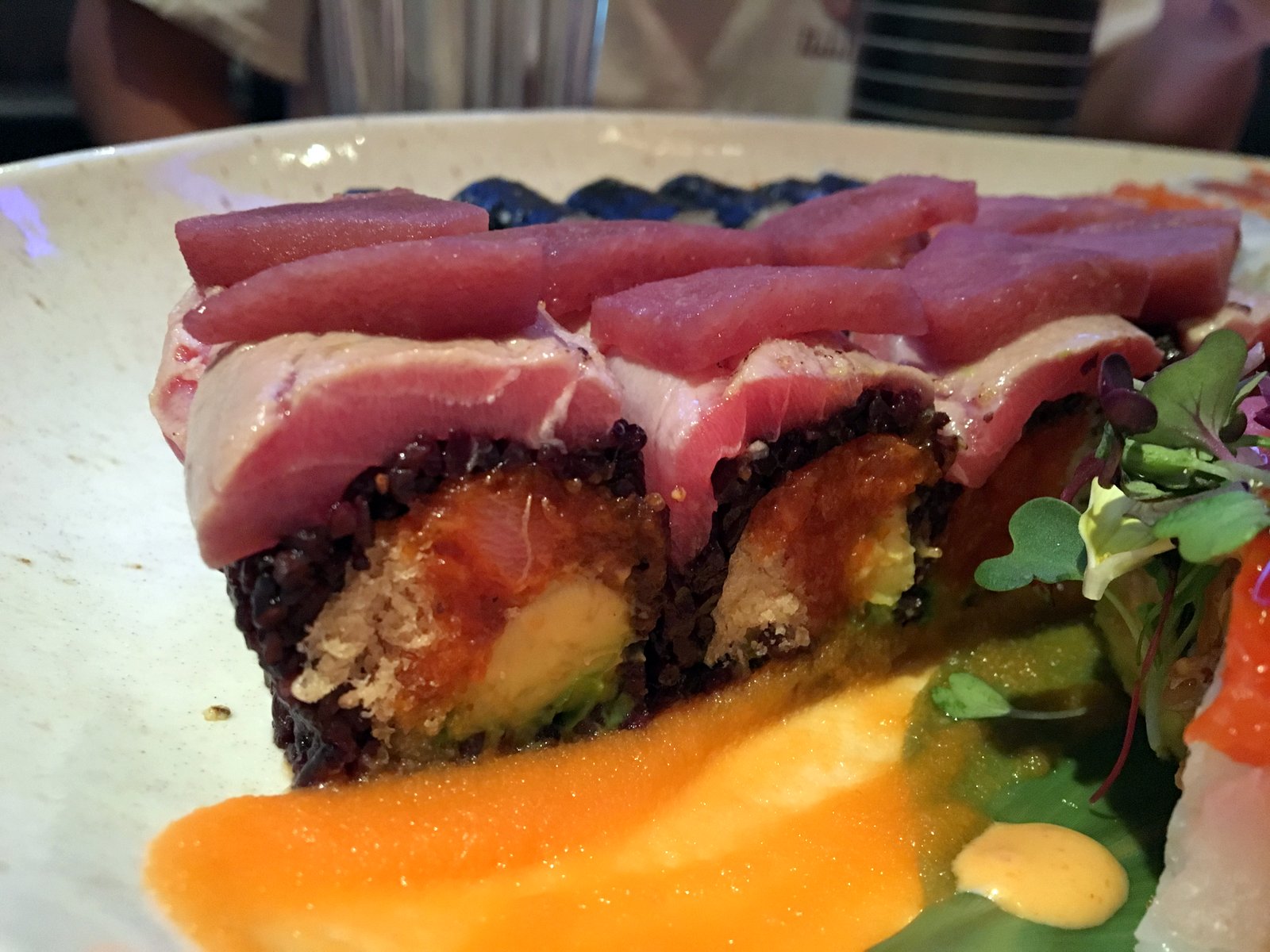
The last special roll we got, I hadn't even seen on the menu when browsing it, but once A pointed it out, I knew we had to get it. It was called the mystic roll ($16), and considering we're Team Mystic in Pokemon Go (and proud of it), it was like it was meant to be. The mystic roll had "spicy tuna, avocado, crunchy, top with seared tuna and red wine pear with black rice and carrot ginger sauce." While we were pretty sure we had gotten the Ajisai roll before, and we knew we had gotten the viking roll before, we were relatively confident that this one would be new for us. We would have remembered eating a sushi roll with crunchy wine-soaked pear on top of it. This roll was really interesting and we liked it. The black rice added a little bit of a different flavor (you could get the other rolls with black rice too, but it costs extra), and it was nicely balanced out with the mild sweetness of the pear and that carrot ginger dressing I've already mentioned we love. It was a good choice, but we would expect nothing less from something called a mystic roll.

We were pretty happy with our Ajisai sushi dinner, and it was exactly what we both wanted for dinner. It's nice having a reliable sushi joint in the neighborhood.

Thursday, June 9, 2016

Week 23 - Deep Frying

Even though I'm doing the 52 week cooking challenge just for myself (and not for points on Reddit), I really hate skipping a week and breaking my streak. I've only skipped a week once - molecular week during the first year I did the challenge (the reasoning explained here) - but I doubled up some other challenge weeks to "make up for it." The Week 23 theme this year was deep frying, which I just don't do at home. I don't cook much (if any) red meat at home, and I don't deep fry. Those are basically the only "rules" I have, which keep our home cooking a little bit healthier, but it also means I don't have to deal with my issues with deep frying (wasted oil, possible burns since I'm a giant klutz, the fear of burning the kitchen down). I didn't want to skip the week altogether though, so I figured I would just pan fry something. I ended up doing shallow frying for the first time, and since the challenge is all about stretching your boundaries and trying something new, I think this should count as much as deep frying for me since the effect on me is pretty much the same.

Chicken not pictured because it had been thawing in the sink

Just like Week 22, I ended up finding a good recipe for this challenge from the Everyday Harumi cookbook. This time it was for fried chicken with a leek sauce. The original recipe called for deep frying the chicken, but I planned to modify the recipe to pan fry it. The ingredients for the fried chicken dish (as adapted) were:

for the chicken:
- 3 boneless skinless chicken breasts ($4.50)
- 1 tbsp low sodium soy sauce ($0.05)
- 1 tbsp sake ($0.10)
- potato starch to coat chicken (about 6 spoonfuls) ($0.40)
- canola oil for frying (a few tbsp) ($0.30)

for the leek sauce:
- about 1 cup of leeks, finely chopped ($0.70)
- 1 red chili pepper, seeds removed and finely chopped ($0.28)
- 1/2 cup low sodium soy sauce ($0.20)
- 1 tbsp sake ($0.10)
- 2 tbsp rice vinegar ($0.10)
- 1.5 tbsp sugar ($0.10)
- 1 tbsp canola oil ($0.10)

The total for the fried chicken was approximately $6.93. We ate it alongside some brown rice and a cucumber salad, which probably added another $3, making the grand total just under $10. Not bad at all.


It was really easy to make the leek sauce. First up was prep - finely chopping the leeks and the chili pepper, and combining the soy sauce, sake, rice vinegar, and sugar in a separate bowl.


To make the sauce, I added the canola oil to a small saucepan, and then sauteed the leeks and chili pepper until soft. After that, I added the sauce bowl ingredients to the pan, stirring frequently to help the sugar dissolve. I started the sauteing right before I started frying the chicken, and cooked it all on low so it wouldn't be done too quickly. I ended up removing it from the heat only a few minutes before the chicken was done.


The prep for the chicken was a little more complex, but still not difficult. After slicing the chicken breasts into smaller, thinner pieces, I added the soy sauce and sake to a bowl and let the chicken marinate for about 10 minutes. After that, I set up a bowl with potato starch to coat the chicken. I was pretty excited because dredging the chicken in the potato starch was probably the best I had ever done at breading something, and I was really proud of that. Unfortunately, I then piled the chicken (coated in potato starch) in a bowl with pieces on top of one another, and let it sit that way for a few minutes while I set up the stove. That meant that when I picked up the chicken to drop it into the oil to fry it, quite a few of them came out missing one side of their potato starch coating. Oops. Lesson learned.


For the frying itself, I added a few tbsp of canola oil to the wok, probably half an inch or less. I was planning to pan fry the chicken, but after I added the first batch (of 2) to the wok, the chicken displaced so much oil that it looked like I was going to end up shallow frying instead. That still worked for the challenge, but I was a little uneasy about it because of the prospect of all of the bubbling hot oil. Sure enough, the oil was boiling loudly at some point, but since the original plan was pan frying, it never occurred to me that I should wait for it to do that before dropping the chicken in. As a result, the first batch of chicken came out missing even more of the potato starch breading since it stuck to the pan.

The second batch, since the oil was already hot enough, came out much better, much more golden brown, much crisper, and with much more of the breading intact. Lesson learned, even if I don't particularly want to do that again. For each batch, I flipped the chicken over partway through (which was a challenge when the breading was stuck to the wok). I don't know exactly how many minutes in that was though, since I did it entirely by sight and guessing. Once the chicken was fried, I removed the pieces with a slotted spoon and let them rest on paper towels to soak up some of the oil. We topped the fried chicken with the leek sauce when it was time to eat.


This challenge meal confirmed for me that frying at home is really not for me, and I should avoid or adapt recipes that require it. I don't think this was so much of a self-fulfilling prophecy as being pretty certain about the reasons I wouldn't enjoy it because I know myself when it comes to some things. The chicken itself turned out okay, even if the second batch was much better than the first, and the leek sauce was really tasty and a good complement for the flavor of the chicken. That said, if I made this again, I think I'd rather just saute and/or bake the chicken and use the sauce. I didn't really enjoy shallow frying that much, and I still have no desire to deep fry at home. I appreciate the challenge for making me try doing this, but honestly, I'm just glad this challenge week is over and hopefully will not return anytime soon.

Wednesday, June 1, 2016

Week 22 - East Asian

The theme for Week 22 was originally miso, but after a bunch of people complained because we already had Japanese week earlier this year, they switched it up to East Asian. I hadn't planned out something with miso before the switch, but decided to make something with miso anyway. It was easier to find something with that theme than trying to narrow down the vast amount of options that would qualify for East Asian. What I ended up choosing was a recipe for udon with a ground meat miso sauce from a cookbook I had borrowed from the library a couple of years ago called Everyday Harumi. I think the original may have been with pork but when I copied the recipe out for my own library, I just wrote ground meat (it's been over 2 years, so I don't really remember).


The ingredients I used for the recipe (as I adapted it) were:

- 1 tbsp canola oil ($0.10)
- 1 heaping cup of frozen leeks, divided ($0.70)
- 1 piece of ginger, about 1 inch long ($0.30)
- 1 lb of ground turkey ($4.30)
- 1/2 hothouse cucumber, seeded ($0.65)
- 3 bunches of dried soba noodles ($2.50)
for sauce:
- 1/2 cup dashi stock ($0.25)
- 1 tbsp sake ($0.10)
- 2 tbsp soy sauce ($0.10)
- 2 tbsp mirin ($0.10)
- 1 tbsp agave ($0.10)
- 4 tbsp miso ($0.55)

Since we got a lot of these ingredients a few years ago, most of the amounts above are estimates. But the total cost came out to about $9.75 for the entire dinner, which was pretty good. (It tops out a little over $10 if you count the other half of the cucumber which we ate as a snack before dinner was ready, but that wasn't technically part of dinner.)


The steps for making the soba with miso meat sauce were:

1. Prep - peel and finely chop ginger; finely chop about 2/3 of the leeks; slice the remaining 1/3 of the leeks vertically; cut cucumber in half lengthwise, remove seeds from cucumber, slice into rounds, and then into vertical slices; mix together miso sauce; boil water for noodles.

2. Heat canola oil in large skillet over medium heat. Add ginger and the finely chopped leeks, and saute for a minute or so.


3. Add ground turkey, breaking it up as it cooks, until fully cooked through.


4. Add sauce to turkey, make sure everything is mixed well together, and cook until sauce thickens. (It didn't really "thicken" so much as get soaked up by the turkey and/or evaporate.) Keep stirring periodically.

5. Make soba (or whatever other noodles) according to package instructions.


6. Add soba to a bowl, cover with the miso meat sauce, and top with garnishes (sliced cucumber and the remaining leeks).


I was skeptical about this recipe after I made the sauce in the beginning, because I tried the sauce and thought it didn't have much flavor. This was when I first mixed it together, before I added it to the meat. A noted that I should be patient because cooking it down would concentrate the flavor. He was right. I was so pleasantly surprised when I had the first spoonful of sauce mixed with meat, after it had cooked for a bit, as the flavor was completely different. The miso really came through, and the sauce was so much more robust and full of flavor. Adding the cucumber and the leeks gave it a lot of freshness and lightness, and overall, it was a really good, well-composed dish. We were pretty happy with this and would make it again. The only thing I'd do differently next time is to use the entire cucumber and even more leeks. It was pretty good as it was, but more vegetables for garnish would probably make it even better.